Showing posts with label film. Show all posts

Wednesday, 3 April 2013

The Classics Club: The Thirty-nine Steps, by J. Buchan


John Buchan is a well-known Scottish author who wrote The Thirty-nine Steps while recuperating from an illness.  The title of the book came from a flight of 39 steps found in this nursing home...


It is considered one of the first "shockers" - combining personal and political drama -, but I actually watched Hitchcock's film adaptation by the same name first:  though not one of his best and memorable, it was adventurous enough to let 1.5 hours pass by.   As I came across the book, though, I wanted to see whether the plot there would be "flat" compared to the film, or whether it would be just as thrilling...


Monday, 4 February 2013

The Classics Club: Persuasion

I read Persuasion by Jane Austen as a teenager, and I must admit nothing stayed from that lecture. I was aware of the film versions of Persuasion (I'm especially fond of the Ciaran Hinds version), so when the first Unputdownables readalong of the year suggested this book, I was favourably inclined to read it - this time as an adult.

The story, a classic girl meets boy, girl loses boy, girl meets boy again and, after some trouble, they all live happily in the end, was sufficiently dusted with social criticism and well developped second characters, as to avoid being just another romantic work of literature...

First of all, I appreciated a heroine being "out of bloom" (that's 27 for you!). Austen acknowledges that there are people in society who will not fall in love, marry and live in peace by the time they're 18. There are missed opportunities and there are regrets that will leave people stranded, moving on in life as respectfully as possible.

Saturday, 14 July 2012

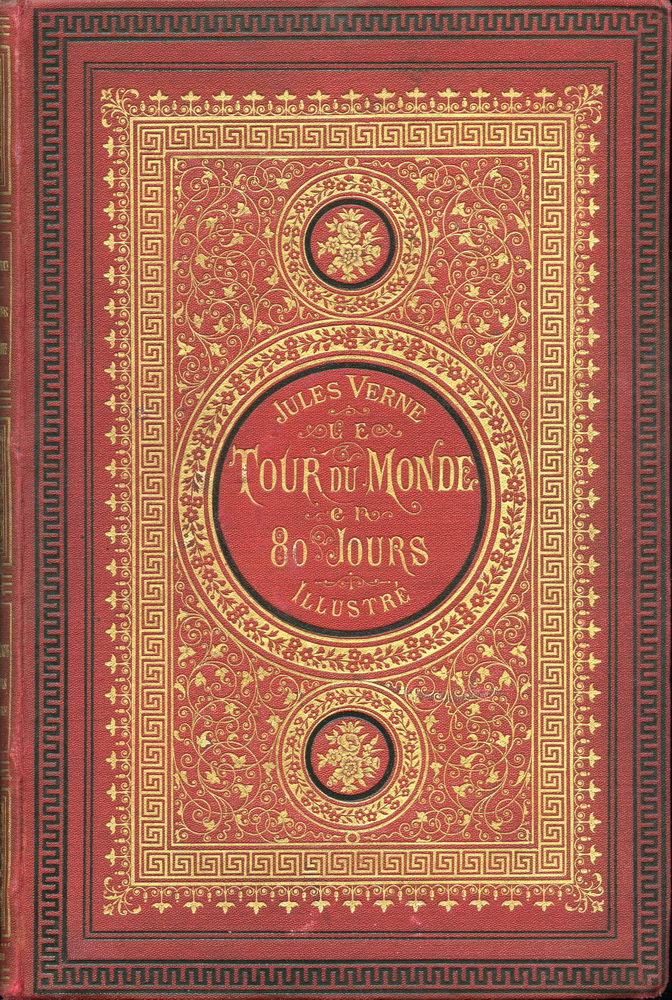
The Classics Club: Le tour du monde en 80 jours (Around the world in 80 days)

What good memories I have from the original film of "Around the world in 80 days" by Jules Verne... All the colours, the sites, the excitement, the adventure! Both as a teenager and as an adult, I've thoroughly enjoyed the whirlwind travel of Fogg and Passepartout...

For my Classics Club, I wanted to read the book as well, to see how Verne had interpreted all these elements in writing.  Also, because I've read other books of his that tend to be futuristic, I was curious to see how he would tackle a non-futuristic subject...

We enter in the life of Phileas Fogg, an Englishman whose daily routine must not be varied:

Sunday, 29 April 2012

The Driver's Seat

I'm thrilled when I see challenges that will help me discover new writers and new genres of literature.  Simon at Stuck in a Box together with Harriet organised this week a retrospective on Muriel Spark, a novelist that I may had heard the name of, but certainly knew nothing about.  Quickly I ordered my copy of The Driver's Seat, to get me into the mood for adventure...  Little did I know that this book would open a whole new horizon - not only for Spark. I prepared myself by reading the reviews posted in the two hosts' blogs, trying to figure out what I was in for - what Spark's style was.  My book is in the 1970's, so I was prepared for an alternative subject.  Still, when I got my copy I knew that I was in for a treat - a wonderful new context was there for me to read and enjoy.
The storyline is quite dark, and I have to say, in line with what my idea of the 1970's would be: already from the first pages, I was inside a futuristic 1970's film, with the heroine, Lise, becoming a hysterical, almost paranoid, overworked (?) woman, who decides to flee.  Within the first 20 pages I knew the end, she would be killed.  Very unusual, but all the more intriguing:  by whom and most importantly, why?

Lise's apartment is really taken out from that decade, all pieces being multi-functional:  "... the furniture is all fixed, adaptable to various uses, and stackable".  I could well imagine how the bed would disappear, the kitchen as well, and how a tiny little apartment would be spacious for entertaining - I've actually watched documentaries on this...

Things go wrong when Lise talks in a baby voice - never a good indicator when it comes to women.  I knew then, even before I read she would be killed, that the book would not have a good ending.  The psychedelic-coloured clothes she's wearing also made me feel uneasy as to her sanity...

She's heading off to Italy, and in her short journey before her death manages to meet a whole array of people (funnily, this never happens to me when travelling):  an Enlightenment Leader (this is, after all, the 1970's), an elderly lady who clings on to Lise, and a series of unimportant men who, as Lise puts it, are not her type... (my, my, are we being picky...)

What puzzled me reading this book, was the rather spastic activities:  it really felt as if I was watching a movie, where separate frames of film were played one after another, with no real continuity. This reinforces the tragic end, and even the hopelessness for Lise - she just didn't stand a chance.  The almost paranoid outbursts she has at various incidents, also work up towards the climax at the end of the book. I could almost feel the eagerness she felt towards her purpose...

The old lady, who will play an indirect role in Lise's demise, provides the humorous (for me) part of the book:  "(Men) want their equality today.  All I say is that if God had intended them to be as good as us he wouldn't have made them different from us to the naked eye... They won't be content with equal rights only.  Next thing they'll want the upper hand, mark my words".  So, if I understand well, we're way beyond the feminist movement, women are now superior to men, and quite soon we'll have the counter-feminist revolution...

I can honestly say I've never read anything like this  book before and am therefore intrigued to find more about Spark's novels. Thanks to Simon and Harriet I've discovered a new writer I want to read more, and thanks to Spark, I've also discovered the Lost Man Booker short-list - another TBR list that will keep me well supplied with books!

-----------------------
For the visual interpretation of this novel, I watched the film by the same name with Elizabeth Taylor.  I fully recommend it - Taylor is as mad as I had imagined Lise to be...


Also read for the European Reading Challenge

Friday, 27 April 2012

The Classics Club: A Room with a View

Many times, the novels I've read as a teenager seem to lose their appeal when re-reading them as an adult.  Others, on the contrary, gain even more allure and highlight new facets to their story.

A Room with a View by E.M.Forster is one such novel.  Having read it while a teenager (and watching the film about 15+ times...), I was still aware of the main characters and the overall plot, but I could not remember whether it was all that good.  As my first novel for the Classics Club, I wanted to carefully read this and put down my thoughts in an objective manner...

The first comment I can make on a Room with a View is definitely politically incorrect:  I had the impression that I was reading a book written by a woman!  I know this is ridiculous, there is no feminine or masculine way of writing, but I honestly found the writing style too focused on petty details, too romantic... too pink!!! (excuse the expression).  It didn't make an impression as such, but that made me pay even more attention on the book...


Moving on, Forster presents an array of situations and happenings to showcase comparisons:  the two main venues in the book are Italy and England:  Italy, the land of freedom, of laughter, of endless meadows with violets, a pure beauty - in sharp contrast with stiff upper-lipped England, full of rules and regulations, with the Church imposing the norms of society, a beauty perhaps only on a first glance... I found the stereotyping very amusing, and mostly spot-on:  I believe the intention here was not to shock the audience, but rather  to move across the "sensitive" subjects rather painlessly, while still making the social criticism.  Very clever indeed...


Lucy and her warden Charlotte find themselves without rooms with a view in Italy.  Such a dramatic event surely cannot be sustained of course, and a respectable complaint starts  being heard in the Pensione.  Upon the offer by the Emersons to swap rooms with theirs that do actually have a view, we witness the hardship of  good manners, taking refuge with the vicar, and finally the obedience towards the decision taken by said priest - the fact that this coincides with the original desire of the ladies, need not bother us... First ...:  things are not always what they seem.  From the perspective of a woman who knows what her position in society is, but who nevertheless wants to accomplish (tiny) things, the procedure to follow is way too time-consuming and complicated:  she has to make everyone think it was their own idea and decision, while she has been plotting the end result since the beginning... "(the women's) mission was to inspire other to achievement rather than to achieve themselves".  Difficult times... (I really laughed when Charlotte wouldn't give the big room to Lucy because young Emerson had it - that worry for absolute protection is bound to have the opposite results).


This difference between the new generation and the established one is also a main theme in this book.  Not only is Lucy rebellious in contrast with her warden Charlotte but also the two Emersons seem to differ immensely - they just don't understand one another.  Only novelists are allowed to cross over to the other side, and hence we have the little devil in the story:  Miss Lavish.  She will inform Charlotte of all possible mischief that can befall Lucy (I believe this is how Charlotte catches Lucy in the meadow and spoils one of the best romantic scenes in literature...) but she is also the source of amusement for Cecil by writing a book on Italy that will inevitably bring George and Lucy together... (I'm starting getting the romance now...)


On to the next set of comparisons, the conservative versus the radical:  the Cecils of this world, who will say to whoever will listen how radical they are, how beyond class they've become, only to prove that they keep the status quo and even worse - they are actually misanthropists:  "of course, he despised the world as a whole; every thoughtful man should; it is almost a test of refinement".  Fortunately, there are also the Georges and Lucies in this world, who may stray in the beginning, when they're still trying to fit in the norms of society, only to realise that life's too short for "trying": there has to be a rebellion, and it has to be now.  Not in the most articulate manner as in Lucy's breaking the engagement off, but all's well that ends well..


Although the novel is full of comparisons / antitheses, it prefers staying on the surface of the matter at the most crucial point - I was surprised when Lucy and Cecil call off their engagement, that the dialogue is plain and civil to the point of being dry - not much information is provided for the inner feelings (or lack thereof) of the two main characters.  That was the only point where I felt I wanted more.


In general, I have to say the novel gave me a lot more food for thought.  The characters are given much more shine and I got much more information on the main characters:  I was surprised, for example, at the very unflattering light Charlotte is portrayed.  I had as reference the film, where Charlotte, while a stiff old spinster, is actually a likable stiff old spinster.  I did not get that feeling at all with the book.  She is to be meaningless, living in a cheerless, loveless world, "a world of precautions and barriers which may avert evil, but which do not seem to bring good...".  There is only one hint at her good soul at the very end of the book.  Interesting to see the difference between writer and filmmaker...


------------------------
For the visual interpretation of this novel, I re-watched the 1985 film by the same name, directed by James Ivory.  I have to agree that the film does the novel more than justice - the points where the novel may lack in depth, are compensated by the actors' interpretation.


Also read for the Back to the Classics challenge-

Thursday, 19 April 2012

The Ministry of Fear

Graham Greene's Ministry of Fear is considered by many to be one of the first examples of spy novels, for which the author would become famous.  My first encounters with Greene were the Quiet American and Travels with my Aunt, which initiated me in the writing style of repressed, unfulfilled situations that would nevertheless exude so much emotion that would amaze me (they still do).  I came across Ministry of Fear at a book auction  - this one was a beautiful leather-bound edition from the late 1940's.  I bought it based on my experience with Greene and because it was such a beautiful book.  Now I would have to read it as well and see whether it was worth the while...

The writing is still the same - the main character, Arthur Rowe, finds himself trapped between a cake that was not meant for him and a murder he did not commit - coming from a background of mercy killing only further complicates his situation.  The alternation between dialogue and third person narrative creates a distance from the depth of emotions that actually take place, and allows (my) imagination to fill in the gaps when the characters remain passive.

While he is trying to figure out what is happening, we follow Rowe through London during the Blitzkrieg and watch as he gets involved in more and more complex situations, while reminiscing his adolescence (at times the scenes reminded me of Hitchcock's "Spellbound", with Dali's beautiful dream sequences).  There is a lot of soul-searching and Greene makes several points to one's childhood and how this is in stark contrast with what we all go through in adulthood:
"none of the books of adventure one read as a boy had an unhappy ending" vs. "he grew up - learned that adventure didn't follow the literary pattern, that there weren't always happy endings" a little further down in the novel

Rowe reaches a point when he cannot take it anymore - he is seriously considering killing himself but decides to at least postpone it when he can be of use to someone - I found it very interesting that even in the direst of conditions, people will cease to be selfish when they can provide companionship (even though Greene believes this not to be an English custom...):
"he was going to live... because he no longer felt that he was dragging round a valueless and ageing body"

We are also introduced to two notions that I spent a lot of time re-reading, to fully grasp their meaning:  
- the economics of terror: "the maximum of terror for the minimum time directed against the fewest objects" ( how does that fit with recent examples of terrorism, I still have to figure out...)
- and the Ministry of Fear itself:  from the initial spread of fear and blackmail in Nazi Germany and copied in other governments, so that no one could depend on anyone (very nice thought, especially in present-day "reality" state of mind, where everyone will betray everyone for 15 minutes of fame) to a permanent fear of disappointing the woman Rowe loves and does not want to hurt: 
"They had to tread carefully for a lifetime, never speak without thinking twice; they must watch each other like enemies because they loved each other so much"

For me the Ministry of Fear proved once more the ability Greene has in providing great food for thought through an unusual story, told by common people ...

*****************
For the visual interpretation of this novel, I watched the film by the same name directed by Fritz Lang (Metropolis) starring Ray Millard (Dial M for murder).  As an old movie aficionado, I was expecting a very good "film noir" interpretation of the book.  The beginning was very promising, but alas that was to be only.  The rest proved to be a very simplified, succinct version of the book, and was rather disappointing...


Also read for the Graham Greene 2012 Challenge


Saturday, 10 March 2012

My man Jeeves

I hadn't realised that one of my favourite great series I've watched over and over again, Jeeves and Wooster, was actually based on the books by Wodehouse.  My man Jeeves would be my first in this collection to devour and feel good about it.

This is a collection of  short stories that starts with the known couple of Wooster and his butler extraordinaire Jeeves.  Primarily describing their adventures in the US, the stories capture the caricatures of the ever so slightly neurotic Wooster on the one hand and of the charismatic and suave Jeeves, trying desperately to get and keep his master out of trouble.

There is an expected template of story -  once you get to understand the steps to it, all other stories are in the same format.  Not that repetition takes away anything from the pure enjoyment, far from it!  Wodehouse gets us back to the early 20th century at the upper-class establishments, where the young (nobility, but of a lesser importance) adults take advantage of their station and get into all types of mischief - getting into girl trouble, depending on the relative's financial contribution, trying to make it into the world as a professional -  there is always something for every taste. 

The stories are written in a style as if the narrator (in most of the stories Wooster) a pal of ours is and he's  talking to us about his misfortunes - the language is very simple and slightly slang, with a quick tempo so as to ensure an easy and comfort reading -- ideal for when tired, but more so when under the weather. Together with a nice hot cup of tea (and some cookies), these stories are bound to cheer me up any time!
I particularly enjoyed those situations where Wooster tries to by-pass Jeeves' recommendations.  This will cause a strain in the relationship and lead to farcical circumstances -- but in the end, and in appreciation of Jeeves' solving yet another direful case, Wooster will succumb to Jeeves' original recommendation.


The character of Wooster is developed to resemble a teenager, having a go at criticising everyone and everything, but always in a good-natured manner.  He's still naive, tries to do the "honourable" thing and help his friends in need.  To that he almost always relies on the help of Jeeves, whom he clearly admires: 

"There is no doubt that Jeeves is in a class of his own.  In the matter of brain and resource I don't think I have ever met a chappie so supremely like mother made"


(credits)
The stories also reminded me of the so-called "screwball comediesduring the 1930's and 1940's - there as here, the storyline is light but not silly, fast-paced, and the situation will inevitably lead to a happy end (after many, many intermediate steps, of course).  


I would say that Wodehouse has managed to capture the essence of the avant-garde (of mischievous youngsters) of his generation and give a faithful description of  challenges they faced.  This, together with the inimitable style of tempo, caricature and empathy, he has established himself in this genre even in our times... 


This post was also published on Project Gutenberg Project 


Tuesday, 6 March 2012

Macbeth


I didn't know what to expect of Macbeth by Shakespeare.  Having only heard small passages of the play in various classic mystery films (the latest was a Columbo episode, where the murderers were actors playing Macbeth and Lady Macbeth),  I was not sure whether all this war theme and blood and madness would appeal to me.


I loved it.  Plain and simple - I loved it.

I enjoyed the gradual degradation in Macbeth's feelings towards the witches' oracles:  in the beginning, when even Banquo tells Macbeth that
"... to win us to our harm, the instruments of darkness tell us truths", 
Macbeth replies:
"if chance will have me king, why, chance may crown me without my stir"
only to shortly afterwards exclaim:
"that is a step, on which I must fall down, or else o'erleap, for in my way it lies. Stars, hide your fires! let not light see my black and deep desires"
before foreseeing doom:
"Will all great Neptune’s ocean wash this blood clean from my hand? No, this my hand will rather the multitudinous seas incarnadine, making the green one red"

and already I had the feeling that Shakespeare insinuates that the trick with the Witches actually the deep immoral thoughts of Macbeth were - he personified his inner want for power to the hated figures to justify the evil taking over his soul and to justify his actions.
Macbeth is further descending into madness when he realises that everyone is his rival - as there are no direct heirs to him, it will be Banquo's children he will have committed the crimes for - therefore they must die.  What an insight into the tortured soul of someone already realising that he's at a point of no return...

Lady Macbeth is a character I couldn't quite make out.  She's portrayed as the evil initiator, asking spirits to
"... unsex me here; and fill me, from the crown to the toe, top-full of direst cruelty!"
but cannot afterwards bring herself to live with the idea of her deeds (or rather her contribution) and dies:
"... unnatural deeds do breed unnatural troubles"
the blood from the first killing has stained her for good and she can't just seem to be able to pull through.  But being such an evil planner, I would never have suspected she would be of a sensitive nature - there, of course, comes Shakespeare to bring everything off balance and provide a twist to the story.  
Her death drives Macbeth further into despair, delivering the perhaps most famous monologue on "tomorrow", on how his life no longer has a meaning, but is rather "a tale told by an idiot... signifying nothing" (I'm still in awe of this monologue - if it's all a tale meaning nothing, then all  the conspiracies, all the deaths are "nothing"? 


A truly great play with yet another innovation - I loved the fact that the most important parts of the play do not actually take place in the main stage, but are rather presented afterwards or only mentioned ... this, however, sent my poor imagination into overdrive -- if I could close my eyes to the horrible scenes I was imagining, I would!

The language used throughout is fairly strong and gory, which is exactly the indication that this is no child's play  -- we find ourselves in a dangerous plot, we witness the darkest hours of human kind through the eyes of Macbeth and Lady Macbeth.  Several of the monologues have become iconic for pointing right at the core of the feelings of the characters, be it the preparation phase for a murder or the time afterwards, when they realise what has been done.  I would even go as far as to say that the play is a series of well-delivered monologues showing the spiralling fall of Macbeth. It's not nice, but it's truly interesting!
On the other hand, I also like the rhyme-like dialogues of the three witches and Hecate, blurring out horrible things in such a pretty way... It's a twisted hilarity to an otherwise solemn play.


I've read the psychological interpretation of Macbeth, but I would rather not see it purely as an essay on ambition / aggression and masculinity - I like to think this is play on the loss of control and morals and the ensuing dangers. A lesson bound to have had an audience in those times...

***

For the visual interpretation of this play, I watched the 1979 version of Macbeth with Ian McKellen and Judi Dench (not yet Sir and Dame at the time). I cannot recommend this version enough - beautiful chemistry between the two, mastery of the gory nature of the play and then there were the monologues - both by Dench on the "come spirits..." but especially by McKellen on "is this a dagger..." and "tomorrow and tomorrow and tomorrow" - they are truly unbelievable and sent shivers down my spine!


Wednesday, 15 February 2012

The turn of the screw

I've heard so many things about The Turn of the Screw,  and about its being the first horror/suspense fiction.  I've also heard about the movies that are based on it, so I've decided to tackle them both:  read the book, watch "The Innocents". 

The book is primarily the diary of a governess that is being read aloud during a Christmas Eve gathering by the fire - already the setting is ideal for attracting the suspense type of story-telling.  A governess new at a place, discovers secrets about her predecessors in the house, her master, as well as about the children in her charge.  Normally, these components would be sufficient to keep my interest quite high.  Being a diary, however, I also felt that, at least in the beginning, the tone was very calm, and I wondered whether the effect would lose its edge because it was not experienced first-hand, but rather described. 


I needn't have worried.  Even as descriptions, the scenes that should be scary are so, and the language used is spot-on for encouraging the appropriate reaction in a group. While reading, I tried imagining how the guy would read it aloud - tried reading it aloud myself - and I found that the intonation was excellent, the capital words used showing the peak of emotion - this is really suspense!  I remember talking about this book in my book club, and already there were people who, after having read it once, did not wish to read it again...


The story-telling is attention-grasping, with only some middle chapters providing a cushion away from all excitement.  The ending is T-O-T-A-L-L-Y unexpected and contrary to all previous practise of the times... also, very ambiguous - who is the devil? Quint or the governess?  Excellent trick - I simply loved it! (sorry, I can't say any more on this!)


The only complaint I have is that I only got to read one side of the story - the governess'.  Especially for the children, I did not feel their characters were fully developed in the story, while they are supposed to be the main actors of this relationship (if there was one) with Quint and Jessel.  Perhaps that was why I can analyse the whole story from two almost different perspectives - the ambiguity is due to the "secrets" left unsaid. But, on the other hand, perhaps that is exactly the purpose of this story!

****
I've had  "The Innocents" for quite some time now, but never gotten around to actually watching it.  Once I had finished the book, I thought that the movie would complement it perfectly.  Deborah Kerr stars in it, as the governess trying to find what has happened in the house.  Now, in general, the movie follows the book in content, but the main differentiation for me was the type of "corruption" to the children.  Whereas in the book I could almost imagine two child-molesters, the movie centred on the pair as "possessing" the children - which in turn adds one more element in the story-telling...  Very good adaptation, very good performance by Kerr but an even better by the children, this is a film best watched like I did, half-asleep (even though I am a veteran in horror movies, I did have my startling moments during the peaks in the story) 


Read for mystery & suspense challenge

Tuesday, 7 February 2012

Pygmalion

Pygmalion by G.B. Shaw has been one of my favourite plays on screen, both in the 1938 and the 1964 versions. I recently also had the pleasure of watching it on stage in London with R. Everett, K. Tointon and D. Rigg. After such an overdose of visual, it was time for the written word to see what the author himself has in mind.

Pygmalion tries to bring the original myth into real life.  In it, a man, disillusioned with women, renounces them and lives alone.  While making a statue of a woman, falls in love with it, and prays for it to become an actual woman - Galateia (and they lived happily ever after...)
With this myth in mind, I set off to reading this play and already I was perplexed - I could not find any romantic predisposition in Shaw's work - everything is so "common" with the details of everyday life, with all the faults, insecurities and expectations.

What I did find, however, was this drive to address gender and class inequality in society (then and now). The play attempts to unite lower and upper class systems as well as male and female roles. As to the characters of the play, they do come through as rather "rigid", each more or less confined to their own boundaries of character.  I had read that this is supposedly a feminist play, given the fact that Eliza is the apparent victor, surpassing her confines, but I would like to raise an issue - She did indeed go beyond her "limits", but primarily because of the push she received by Higgins and Pickering (even if this was done for a bet).  So, I wonder, would she have achieved the same on her own?  Would society have allowed her to go beyond being a flower girl? hmmm....  I'd rather think this play is about the ability, given the chance, we all have to rise above our social status in life and "better" ourselves, just as Eliza did.  It is up to us to take advantage of the possibilities that come our way and emerge victorious...

On other points in this play, I found the use of minor characters an excellent means to showcase the way people treat each other with regard to class distinction. I thoroughly enjoyed Alfred Doolittle, Eliza's father, who is dragged into "middle class morality" and completely changes character...

And one slightly negative (on my part) point on the play - the very long acts.  Being a reader who has to stop at completed scenes (I think it's called compulsive), I had a couple of all-nighters before I could let the book down...

Did I mind that the play does not have a happy ending?  Certainly not!  I actually fully agree with Shaw:

"The rest of the story need not be shewn in action, and indeed, would hardly need telling if our imaginations were not so enfeebled by their lazy dependence on the ready-mades and reach-me-downs of the ragshop in which Romance keeps its stock of 'happy endings to misfit all stories."

As to which of the versions I prefer? I'm afraid it's not the book - rather the 1938 movie vesion (screenplay by Shaw himself, won the relevant Academy award)


Pygmalion (1938)
Leslie Howard, Wendy Hiller


Tuesday, 31 January 2012

One for the money

Patricia is guest-blogging

Last weekend the latest Katherine Heigl movie opened in American cinemas. 'One for the money' is based on the first book focusing on the misadventures of Stephanie Plum a female bounty hunter by Janet Evanovich. Eighteen books have been published in this popular series so far.In 'One for the money' Stephanie has divorced her cheating husband and has been laid off from her job as a lingerie buyer. She has no income and when faced with the prospect of moving back in with her parents she takes a job with her cousin Vinnie who owns a bail bond office. She applies for a post as a clerk but when she finds that the position has already been filled she becomes an 'apprehension agent'. Her first job is to find Joe Morelli, a vice cop suspected of murder, with whom she has a 'history' and is the local bad boy. Stephanie has no clue how to find and apprehend him and stumbles from one hilarious situation to another but through sheer luck and determination she 'gets her man'. She is surrounded by a series of colourful characters which include her matchmaking mother, gun crazy grandmother, a fellow bounty hunter named Ranger.

The books are written in the first person and Stephanie's view on life, her family and friends are very honest and often laugh out funny :

'There are some men who enter a woman's life and screw it up forever. Joseph Morelli did this to me – not forever, but periodically'.

'Two years ago, when Grandpa Mazar's fat-clogged arteries sent him to the big pork roast in the sky, Grandma Mazur had moved in with my parents and had never moved out. My father accepted this with a combination of Old-World stoicism and tactless mutterings.'


I have to admit that I read the first three books of the series in a row : 'One for the money', 'Two for the dough' and 'Three to get deadly' but by the third book I was tired of the uniformity of the books. This does not often happen to me since when I find an author or series of books I like, I tend to devour every single book I can get my hands on. I am not saying that the books are bad or not well written, I just found that they have to be read in dollops and I intend to go back to this series every once in while.

Now to get back to the movie. There has been a lot of controversy surrounding the movie since a number of people have said that Katherine Heigl was not who they imagined playing Stephanie Plum and Joe Morelli has been changed from an Italian American to an Irish American as he is being played by Jason O'Mara (from the US version of Life on Mars and Terra Nova). Daniel Sunjata has been cast as Ranger and viewers of Grey's Anatomy will recognise him as the good looking nurse who catches a certain doctor's eye and I predict that he will be 'one to watch'. I have seen the trailer of the movie and despite the controversies mentioned above it seems to be quite faithful to the book. The reviews of the movie have not been flattering but I will definitely be watching it to see how it compares to the book and to see the great Debbie Reynolds as Grandma Mazar.

Friday, 27 January 2012

The Great Gatsby - the end

Yes, it's over.
I'm through reading the Great Gatsby and I'm at a loss.  Why? WHY?
Why does such a wonderful story have to end in such an abrupt manner?

In this part, Gatsby receives his last analysis of character.  We see him when he's first introduced to Daisy and her world.  He's gobsmacked with this new feeling of "breathless intensity" and "the ripe mystery" that surrounds Daisy's world.  Daisy is also a hot ticket, with many admirers around her.  Gatsby wants to be part of this world and "own" Daisy, and hence his road to accomplishments.

Compared to the previous parts, this one contains the final highlights to a tragic story.  Here we get to see the utmost betrayal of a human to another human:  Tom and Daisy vs. Gatsby:  

"They were careless people, Tom and Daisy -- they smashed up things and creatures and then retreated back into their money or their vast carelessness or whatever it was that kept them together, and let other people clean up the mess they had made..."  

The story of the accident and the subsequent havoc is described very fast (I suppose this is how fast it happens), so much so that I actually had to go back and re-read the part, because I had the feeling I had missed something.  But no, it's over in less than a page...


I feel sad.  Even though the portrait of Gatsby has many flaws, I felt there is genuine wish on his part to improve.  For whatever reason, I'm not sure, but he - at least - is the one character retaining his integrity throughout the book.  He doesn't adapt according to wishes or needs, he doesn't change according to society's whims.  After the accident, I began reviewing all the previous parts, in a new light now.  How superficial society can be! Top actors certainly are Tom and Daisy, but even Jordan now seems a colourless and tasteless creature.  One minor character is introduced in this last part, Gatsby's dad, a nice, charming old man.  And here we learn that Gatsby was actually financing his dad's life.  Even though he refused to adopt his parents' credo for a simple life, did he perhaps see the beauty and realism of it?  Or perhaps he realised how futile his obsession with the "fake" past was?  the past that in the end came back to claim his life...


All in all, an excellent piece of in-depth literature that I would recommend to everyone - great topic for a read-a-long, chosen by Wallace at http://unputdownables.net/

*******

I waited patiently until I had finished the book to re-watch the original Gatsby movie with Redford and Farrow.  How great this movie is - what great performances at just the right dose each!  I cannot imagine how the remake will try to live up to these standards... I suppose I will watch it at some point, but I can't honestly say whether I'll ever choose Di Caprio over Redford...

Wednesday, 25 January 2012

A mid-summer night's dream read-a-long

An interesting readalong on the net is Reading Shakespeare - a play a month... an ingenious idea and within a time frame that is feasible even for someone with a überfull-time job like myself... My solution to separating the readalongs with the challenge and book club reading, is to dedicate my weekends to the readalongs, and to read all other books over the week (I am organised, if nothing else...)

A mid-summer night's dream is a well-known fairy tale of love, betrayal and tricks... all the right ingredients for a havoc made in fairyland...

Shakespeare starts off with the main cause of distress in Athens: a strange love-triangle, with Hermia loving Lysander but being loved by Demetrius, who shuns Helena, who's in love with Demetrius... Oufff! Already the complications show the way to how the story proceeds... I find it weird that Demetrius would insist on marrying Hermia who doen’t love him, or the Helena would be so infatuated with Demetrius (but then again I am a present-day cynic…). The only couple that seems closer to today's standards is Hermia and Lysander, but there, as well:

"The course of true love never did run smooth"

Why the use of magic and fantasy in this play? I believe that the fantasy world is the only chance we get to find and express our true feelings, our gateway from the “real” world, with all its boundaries and insecurities – then but even more so now. 

Shakespeare also uses quotes to reach the desired effect: Egeus talks about his daughter Hermia “As she is mine I may dispose of her” (grrr…) but even Theseus, the duke, telling her “To you your father should be as a god” (double grrr…) – of course I was laughing while reading these quotes, but nevertheless they made me wonder how much this exaggeration could highlight the difficulties people faced (and face) when not following the "accepted" road (in love, but also in other matters). 

An on to the world of fairies. I found Act II especially poetic (I suppose it fits perfectly with the fairy world) and I thoroughly enjoyed the reference to Cupid and I suppose Elisabeth?? Because if it is indeed Queen Elisabeth, I can understand the reference made by Hermia to Lysander to keep a distance… 

Various misunderstandings happen, and affections change among the different couples - in real life this would be considered a serious matter, but in the play it's described in a merry and lighthearted manner. This made me wonder whether the play is about love at all: if I compare it to Romeo & Juliet (an exaggerated example, I agree) I cannot see the same depth of character or use of language. I start to think whether this play is not  a slight mockery of what people do for (or because) of love (with the help of Puck!). 


What is beautiful about Shakespeare's plays is, of course, the language.  If someone else took these same elements of the story and tried to present it to me, I would not be amused...  But, here, every flower brings a note of something in the story, every time Puck speaks, I feel like wandering off to the woods... Those who have watched stage productions get a different glimpse into the world of Shakespeare, but I, a non-native speaker, am also content with the Hollywood version of 1999, which I admit is not that bad:  when the play executed nicely, the language comes alive (which it is) and paints bright stars in the night...


That night when everything seems to go wrong... wrong people/fairies get the potions, horrible truths come up in the air (dwarf?  where are your stiletto heels, woman???) and insecurities rage in the air while someone becomes an ass... And for all that we blame a tiny bit of potion?  Can it be that love is so magical, that any confusion and disorder can only be because of a "trick"? are we mortals so without magic, that we don't have the capacity to feel perplexed otherwise?

In the following act, I have my only two objections in the play:  the one where Oberon requests the child from Titania in exchange for undoing the spell, which he receives -- a very thin line between the magic of love and blackmail? And then Demetrius is still under the first spell when love is restored between him and Helena.  No true feelings of love, then.  But all is all right, balance is restored, and as the magic of the night is undone, the sun rises and there are two weddings take place. 
Here again, Shakespeare is innovative:  he could very well have put a full stop and be done with the play.  But he chooses instead to focus on the sub-plot of a play within the play, of Pyramus and Thisbe, to provide some enjoyment to the public, after the "crises" presented before.

I must admit that from all the characters in this play, I thoroughly enjoyed Puck -- he's such a naughty, little creature that I can't but like him (and the fact that he's interpreted by S. Tucci in the film is an extra bonus...) and I particularly like the ending, that makes sure that the audience will leave in good mood (ingenious Shakespeare at his best):

"If we shadows have offended,
Think but this, and all is mended,
That you have but slumber'd here
While these visions did appear.
And this weak and idle theme,
No more yielding but a dream,
Gentles, do not reprehend:
if you pardon, we will mend:
And, as I am an honest Puck,
If we have unearned luck
Now to 'scape the serpent's tongue,
We will make amends ere long;
Else the Puck a liar call;
So, good night unto you all.
Give me your hands, if we be friends,
And Robin shall restore amends".

Monday, 23 January 2012

The Hunger Games Trilogy


Patricia is guest-blogging


The Hunger Games Trilogy is a Young Adult series written by Suzanne Collins.  The books in the series are 'The Hunger Games', 'Catching Fire' and 'Mockingjay'.  When first published, they were compared to the 'Twilight' series,  but the only things they have in common are that they were written for young adults and include a love triangle involving the heroine and the two boys in her life.

The books are set in a distant future where North America, now known as Panem, has been divided into thirteen sectors each specialising in a specific trade or industry.  Following an unsuccessful rebellion against the Capitol, each district has to supply one girl and one boy every year to take part in the Hunger Games.  These games are literally a televised fight to the death.  The heroine is Katniss Everdeen from District 12, who volunteers for the games when her younger sister is picked in the lottery which chooses the participants. She is sent to the capitol with Peeta Mellark, the baker's son and asks Gale, her childhood friend and hunting companion, to look after her family in her absence.  The book vividly describes the preparation and training before the games begin and introduces a number of colourful secondary characters such as Haymitch, a drunk who is the only living winner from the 12th district.  There are some very visual descriptions of the clothes they wear, the weapons they use, the games and the choices the competitors make to survive at any cost even if it means killing their friends.   

Suzanne Collins has said that she got the idea for the books while watching reality tv.  She paints a harsh world where people are subjugated and starving and teenagers do everything they can to win and survive.  I had to constantly remind myself that the targeted audience were young adults. The leaders are corrupt and brutal, particularly in their methods to keep the districts under control. 'Catching fire' and 'Mockingjay' delve deeper into the politics of Panem and are just as riveting as the first book.  

The books are being adapted into film with the first movie scheduled to be released in March 2012.  Jennifer Lawrence has been cast as Katniss, while Josh Hutcherson and Liam Hemsworth have been cast as Peeta and Gale. The movies, like the books, are being hyped as the next big thing since Twilight and the production company has already been generating a lot of buzz in the media releasing pictures of the cast and production news on a regular basis.  A number of websites have also been commenting whether a movie revolving around a game were teenagers kill each other is suitable for the targeted audience.   I, on the other hand, am curious to see how they will bring the imagery of Suzanne Collins to the big screen, her descriptions are so good that I already have a visual image in my mind of the clothes worn (in particular the fire dress of Katniss) and various scenes of the book such as the opening ceremony of the games.  I will definitely be queuing up at the cinema to judge for myself when the movie is released. 

ShareThis

LinkWithin

Related Posts Plugin for WordPress, Blogger...